 04 Nov 2026

Recently, the team led by Professor Xiang Ma at the School of Chemistry and Molecular Engineering, ECUST, made a major breakthrough in heating-activated high-temperature phosphorescent gel materials. The findings, titled “Gel Displays Heating-Activated Wavelength-Tunable High-Temperature Phosphorescence,” were published in Angewandte Chemie International Edition.
Organic room-temperature phosphorescent materials have great potential for applications in information storage, encryption and anti-counterfeiting, and sensing and detection because of their long emission lifetimes and large Stokes shifts.
However, in most phosphorescent systems, higher temperatures intensify molecular motion and accelerate the nonradiative decay of triplet excitons, weakening or even completely quenching the emission. Developing phosphorescent materials that combine high-temperature tolerance, tunable emission wavelengths, and heating-activated emission has long been a major challenge in this field.
To address this challenge, Professor Ma’s team proposed a strategy based on the synergy of multiple interactions. They doped the triphenylamine derivative TPCS into a calcium polyacrylate (PAA-Ca) matrix to construct a heating-activated phosphorescent gel.
The resulting hydrogel did not emit phosphorescence at room temperature. When heated, the system underwent thermally induced phase separation, which switched on and enhanced phosphorescence. This behavior was the opposite of that of conventional phosphorescent materials, whose emission is quenched by heat.
After the water was removed by continuous heating, the rigid microenvironment formed through phase separation was permanently fixed, yielding a xerogel. The xerogel showed a reversible blue shift in its phosphorescence wavelength from 505 nm to 450 nm. Its afterglow remained visible to the naked eye at 473 K, while a phosphorescence signal could still be detected at 573 K, with a lifetime of about 9 ms. After 10 high- and low-temperature cycles, the material largely retained its phosphorescence performance, demonstrating excellent cycling stability.
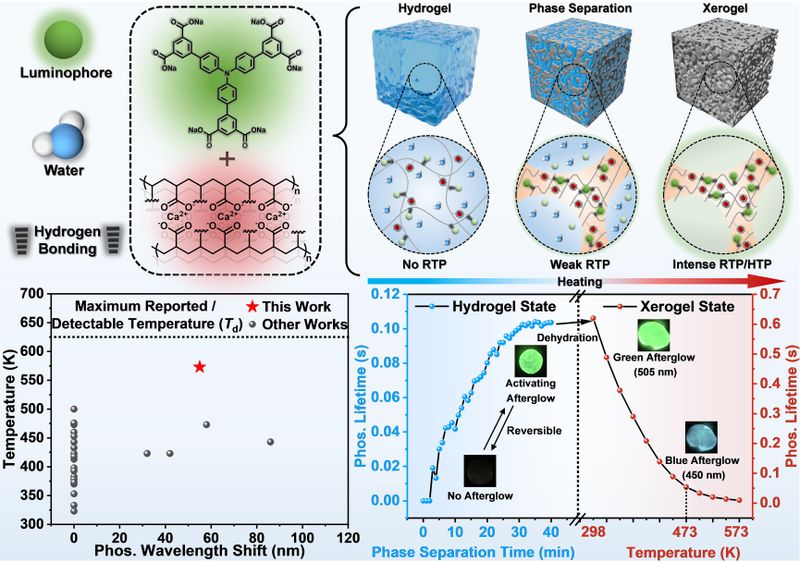
Mechanistic studies showed that the material’s strong high-temperature phosphorescence resulted from the combined effects of several interactions within the matrix. Hydrogen bonds provided a rigid environment for triplet excitons. Ca²⁺–COO⁻ coordination cross-linking gave the system high thermal stability and triggered thermally induced phase separation. The locally confined environment formed through phase separation then enabled high-temperature phosphorescence.
Together, these interactions overcame the limitation of individual hydrogen bonds, which readily dissociate at high temperatures, and effectively suppressed the nonradiative transitions of triplet excitons. Experiments showed that thermally induced phase separation could build molecular rigidity on demand, turning heat into a trigger for phosphorescence rather than a cause of quenching. This finding provides a new approach to designing phosphorescent materials with high thermal stability and tunable wavelengths.
Taking advantage of the material’s heating-activated emission, temperature-dependent wavelength tunability, and controllable afterglow duration, the team explored several practical applications. They developed thermally switchable QR-code information storage that could be read in high-temperature environments, visual temperature sensing for electronic devices based on the temperature-dependent afterglow color, and time-controlled multilevel information encryption based on the time-dependent decay of afterglow. These applications provided new material solutions for information security and visual temperature monitoring under high-temperature conditions.
Professor Xiang Ma and Research Associate Professor Siyu Sun are the corresponding authors of the paper, and PhD candidate Yufeng Huang is the first author. The research was supported by the Basic Science Center Program of the National Natural Science Foundation of China and the National Science Fund for Distinguished Young Scholars.