 04 Nov 2026

Recently, the Clean Energy Materials and Devices Group from the School of Materials Science and Engineering at ECUST reported new progress in dopant regulation of single-particle photocatalysts for overall photocatalytic water splitting. The findings, titled “Anisotropic Facet Doping Amplifies Built-In Electric Field in Single-Particle Photocatalysts,” were published in Advanced Materials.
Using Al-doped strontium titanate (SrTiO₃:Al), a representative model photocatalyst, the researchers revealed anisotropic facet doping of Al and its role in regulating the built-in electric field at the single-particle level, providing new insights into semiconductor doping effects.
Elemental doping is widely used to tailor the electronic structure and charge-carrier dynamics of semiconductors. Although Al doping has long been known to improve the photocatalytic performance of SrTiO₃ by suppressing defects and regulating crystal growth, how dopants are spatially distributed within individual particles and how this distribution influences charge separation have remained unclear. In particular, the effect of facet-selective doping on charge-carrier migration in SrTiO₃ crystals exposing reduction {100} facets and oxidation {111} facets has yet to be fully understood.
To address this question, the team synthesized SrTiO₃:Al single crystals with well-defined {100}/{111} facets using a two-step molten-salt method while preserving the particle morphology. Advanced electron microscopy and depth-resolved elemental analysis revealed that increasing the nominal Al doping level from 0.5 mol% to 4.0 mol% transformed the dopant distribution from nearly isotropic to strongly anisotropic across facets. At a nominal Al doping level of 4.0 mol%, the local Al content along {111} was more than twice that along {100} at the same depth. Combined with spectroscopic characterization and first-principles calculations, the study showed that this facet-selective Al incorporation enhanced the inter-facet electrostatic asymmetry associated with the intrinsic built-in electric field, promoting directional migration of photogenerated electrons toward the {100} reduction facets and holes toward the {111} oxidation facets.
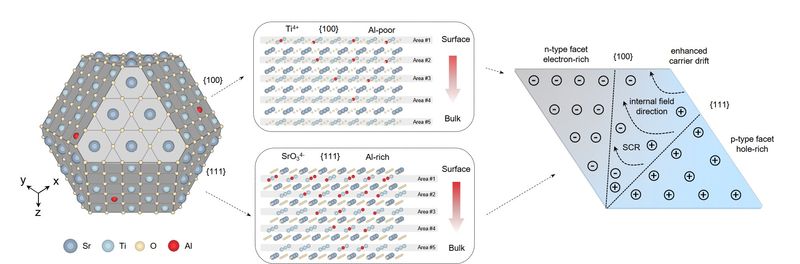
The enhanced charge separation was further confirmed by selective photodeposition and surface photovoltage measurements. After loading Rh/Cr₂O₃/CoOOH cocatalysts, the 4.0 mol% Al-doped SrTiO₃ achieved a hydrogen evolution rate of 3364.13 μmol·h⁻¹ for overall water splitting, producing H₂ and O₂ in a stoichiometric ratio close to 2:1, with an apparent quantum yield of 81.1% at 335 nm. Similar anisotropic facet distribution of Al was also observed in BaTiO₃ single crystals, suggesting that this mechanism is broadly applicable.
The study advances the understanding of doping effects in the classical SrTiO₃: Al model system from conventional average dopant concentration toward spatially resolved dopant distribution and local electronic-structure regulation, providing a new design principle for highly efficient particulate photocatalysts.
The research was carried out by PhD candidate Pengcheng Ding from the School of Materials Science and Engineering under the supervision of Professor Huagui Yang, Associate Professor Pengfei Liu, and Professor Sheng Dai from ECUST, as well as Professor Xie Zhang from Northwestern Polytechnical University. The work was supported by the National Key Research and Development Program of China, the National Natural Science Foundation of China, and the Shanghai Pilot Program for Basic Research.