 04 Nov 2026

Climate change poses a serious global challenge, making large-scale reduction of carbon dioxide emissions an urgent priority. Steel, chemical and other key industries in China generate flue gas with complex and variable compositions. Conventional carbon capture, utilization and storage (CCUS) technologies struggle to separate CO₂ from such mixed flue gas, suffering from low efficiency and high energy consumption.
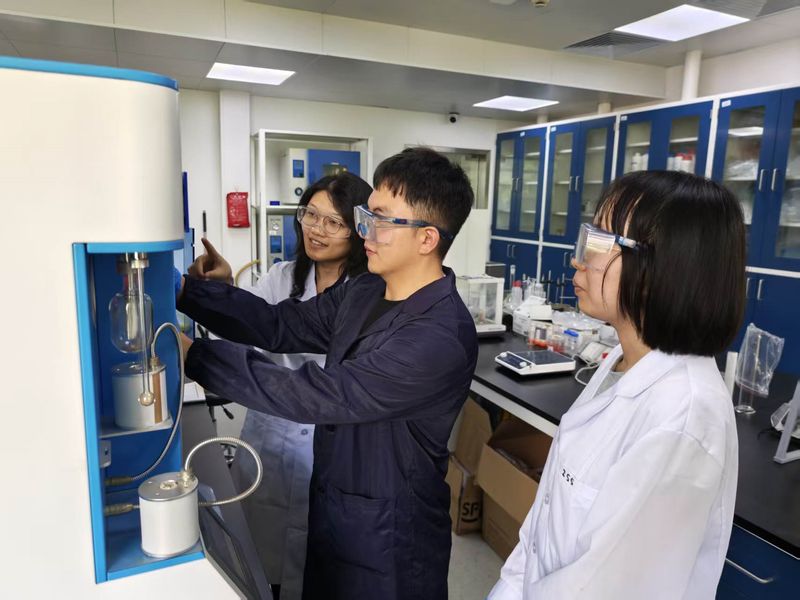
Led by Professor Chengcheng Tian, a research team from ECUST has developed an integrated technological pathway encompassing “capture-regeneration-conversion”. Their full-chain technology for CO₂capture, conversion and utilization from industrial flue gas was showcased at the 26th China International Industry Fair (CIIF).
By elucidating the relationships among flue gas turbulent flow, droplet movement and CO₂ mass transfer and transformation, the team developed principles, processes and equipment based on micro-interfacial oscillation for capture, regeneration and reaction. This innovation enables a full-chain pathway of low-cost capture, low-energy regeneration and syngas production via dry reforming of CO₂ with methane.
Conventional CCUS faces three challenges: large equipment footprints, high energy consumption and poor stability. To tackle these bottlenecks, the team achieved breakthroughs at each stage of the process.
In the capture stage, micro-interfacial oscillation intensified gas-liquid mass transfer, cutting equipment height and land footprint by over 45%. In the regeneration stage, swirling flow and micro-interfacial oscillation of droplets strengthened heat transfer and CO₂ desorption, reducing regeneration energy consumption by more than 35%. In the conversion stage, a dual-active-site catalyst and reactor maintained a dynamic balance between carbon deposition and removal.
The conversion rates of both CO₂ and CH₄ exceeded 85%, syngas selectivity approached 100%, and the catalyst service life surpassed 4,000 hours. The resulting syngas can be used to synthesize high-value chemicals such as methanol and olefins.
A 100-tonne-scale pilot test was conducted at the No.2 hot-blast stove flue gas system of Shanghai Meishan Iron & Steel Co., Ltd., China Baowu Steel Group Corporation Limited, in Shanghai. The facility operated stably for over three consecutive months with a CO₂ capture rate above 95%. The capture cost dropped from 380 CNY/tCO₂ to around 190 CNY/tCO₂, and total system energy consumption was reduced by more than 40%. Compared with coal-based syngas production of the same scale, carbon reduction exceeded 60%.
The team has published more than 10 papers, led the formulation of three chemical industry standards and was granted 14 patents. The technology received First Prize of Sichuan Provincial Science and Technology Progress Award in 2025. A 10,000-tonne-scale demonstration project is under development. This modular technology offers a pathway for the low-carbon transition of steel and chemical sectors with remarkable environmental and economic benefits.